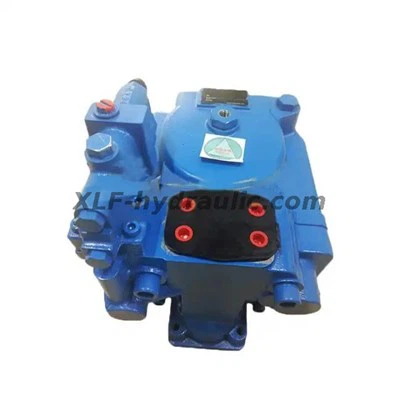
If you've ever stood near a construction crane lifting a steel beam, or watched a farm tractor power through muddy fields, you've witnessed axial piston motors at work. These unassuming workhorses convert hydraulic pressure into the rotational force that keeps heavy equipment moving, and their performance hinges on a hundred tiny, precise details-none more critical than the surface finish of their pistons and cylinders. As a supplier that relies on these components to deliver reliable, long-lasting motors for industries ranging from agriculture to material handling, I've spent years digging into how even the most subtle variations in surface texture can make or break a motor's efficiency, lifespan, and overall performance. Today, I want to pull back the curtain on that relationship, and explain why this often-overlooked factor is so essential for anyone who depends on axial piston motors.
Let's start with a quick refresher on how axial piston motors operate, because context matters. At their core, these motors have a cylinder block lined with multiple pistons that slide in and out of bores cut into the block. When pressurized hydraulic fluid is pumped into these bores, it pushes the pistons outward against a rotating swash plate, which translates that linear motion into rotational torque. The pistons and cylinder bores have to form a near-perfect seal-tight enough to stop fluid from leaking past, but smooth enough to let the pistons slide freely as the motor runs. That balance between sealing and mobility is entirely controlled by the surface finish of both parts.


Surface finish refers to the tiny, irregular peaks and valleys left on a metal surface after machining, grinding, honing, or finishing processes. It's not just about being "smooth"-two surfaces can look equally smooth to the naked eye, but have drastically different microscopic textures that change everything about how they interact. For pistons and cylinders in axial piston motors, the key metrics are usually roughness average (Ra, measured in micrometers), peak count, and the direction of the surface's grinding or honing lines. A Ra value of 0.2 micrometers, for example, is extremely smooth, while a Ra of 1.6 micrometers is more like a brushed metal finish-both are used in hydraulic components, but for very different reasons.
First, the most immediate effect is on volumetric efficiency. Volumetric efficiency is how much of the hydraulic fluid that enters the motor actually makes it through to produce torque, versus how much leaks past internal parts. If the surface of a piston or cylinder bore is too rough, the tiny gaps between the two parts become uneven. High-pressure hydraulic fluid seeps into the deep valleys of the rough surface, which creates a leak path between the high-pressure side of the motor and the low-pressure return side. That leak wastes energy, reduces torque output, and forces the motor to work harder to make up for the lost fluid. Over time, that leakage gets worse as the rough peaks wear away, creating even larger gaps and a vicious cycle of declining efficiency.
On the flip side, a surface that's too smooth also causes problems. Wait, that's not a typo-perfection can be a flaw here. If the surface is polished to a mirror-like finish (Ra values below 0.05 micrometers), there's not enough microscopic texture to hold a thin layer of hydraulic oil between the piston and cylinder. That leads to metal-to-metal contact, rather than the lubricated boundary layer that should separate the two parts. No lubrication means increased friction, heat buildup, and accelerated wear on both the piston and cylinder. Think of it like sliding two pieces of glass across each other-they feel smooth at first, but without any oil between them, they seize up almost immediately. For axial piston motors, that seizure means downtime, costly repairs, and even total motor failure.
I've seen this play out firsthand with motors we've supplied for construction equipment. A few years back, we had a customer working on a road grading project who asked for a custom motor with a polished piston finish, thinking it would be more durable. Within three months, their motor seized up mid-project, leaving them stuck with half a mile of unfinished road. When we took it apart, we found the pistons and cylinder bores had burned away from extreme friction-all because the overly smooth surface had stripped away the lubricating oil film. Since then, we've adjusted our specifications, recommending a Ra value between 0.4 and 0.8 micrometers for most standard axial piston motors, a sweet spot that balances leak resistance and lubrication.
Next up, lifespan and wear rate. The surface finish of pistons and cylinders directly affects how quickly these parts wear over time, which is the single biggest driver of motor longevity. When surfaces are properly finished, the tiny valleys create tiny reservoirs for hydraulic oil, ensuring that even under high pressure, there's always a thin layer of oil separating the metal parts. That reduces direct contact and friction, so the pistons and cylinders slide against each other instead of grinding. The peaks of the surface, when precisely controlled, also wear in gradually instead of breaking off in chunks. If the finish is too rough, high peaks can catch on each other as the piston moves, causing micro-scratches that quickly turn into deep gouges. If it's too smooth, as we saw with the road grader, there's no buffer against friction, leading to adhesive wear where metal particles from the piston stick to the cylinder and vice versa.
Another less talked-about factor is noise and vibration. Axial piston motors that vibrate excessively not only make for an uncomfortable operator, but also put extra stress on the motor's internal components, leading to faster failure. A poor surface finish can create uneven piston movement as they slide in and out of the cylinder bores, causing small, repeated shocks that turn into vibration. A well-finished surface, by contrast, provides consistent, smooth movement for each piston, reducing vibration levels by up to 20% in some cases. For equipment used in urban areas, where noise regulations are tight, this isn't just a quality issue-it's a compliance one.
Environmental conditions also change how surface finish impacts performance. For motors used in extreme environments-like mining equipment that operates in dusty, high-temperature conditions, or agricultural equipment that's exposed to mud and debris-the surface finish becomes even more critical. Rough surfaces are more likely to trap dirt and debris, which act like tiny abrasives that scratch the piston and cylinder bores every time the motor runs. In dusty mines, we've found that motors with a slightly rougher finish (Ra around 0.8 micrometers) hold lubrication better and repel small dirt particles more effectively than overly smooth or overly polished surfaces. That's why we tailor our finish specifications based on the end application, not just a one-size-fits-all approach.
Now, let's tie this to real motors we supply, because I know our customers care about tangible results. For example, the Ingersoll Rand PRO PAC70 SD-70d Torque Hub R7c217458 Drive Motor has pistons and cylinders finished to a Ra of 0.6 micrometers, optimized for high-torque applications in heavy construction. We tested this motor in load tests at our facility, and it maintained 92% volumetric efficiency after 1,000 hours of continuous operation-something we attribute directly to its precision surface finish. Similarly, the ABG Volvo Gearbox ReducerSet 80615008 used in road pavers has a custom honed cylinder bore finish that reduces leakage in high-pressure, continuous-use scenarios, making it ideal for 12-hour work days.
For low-speed, high-torque applications like self-propelled mixers, the MP125 Gerotor Hydraulic Motor - Low Speed High Torque For Self-Propelled Mixers | CE uses a modified surface finish that balances wear resistance and torque output. Mixers run at slow speeds under constant heavy load, so their pistons need to slide smoothly without leaking, and their finish is calibrated to handle the start-stop motion common in mixing operations. Even our smaller motors, like the BMK2-315-WE-G-SU Hydraulic Motor ASSY 315cc | Wheel Mount Flange, 31.75mm Shaft designed for wheel drives, get the same careful finishing process-smaller motors often have tighter tolerances, so their surface finish is even more precise to avoid premature wear.
When it comes to replacement or aftermarket motors, like the 112-1206-006 Eaton Charlynn 500cc Splined Shaft Hydraulic Motor, we often recommend matching the original equipment's surface finish if you're replacing a worn motor. A common mistake we see is customers buying a generic replacement motor that has a poor surface finish, leading to faster breakdowns than the original. Taking the time to check the Ra value and surface texture ensures the replacement motor will perform as well as the original, saving you money on repairs and downtime.
So, how do we get the surface finish right at our facility? It's a multi-step process that starts with machining the cylinder block and pistons to within micron-level tolerances, then moving to honing, a process that uses abrasive stones to create a uniform, controlled texture. We don't rush this step-honing takes several hours per part, because even a tiny variation in pressure or speed can throw off the surface texture. After honing, we do a micro-polishing step to remove any sharp peaks, but we leave enough of the valley texture to hold oil. We also inspect every part with a surface profilometer, a tool that maps the microscopic texture to ensure it meets our exact specifications, before the parts go into assembly.
Looking ahead, as industries like construction and agriculture demand more efficient, longer-lasting equipment, surface finish will only become more important. New technologies like laser texturing are allowing us to create custom surface patterns that further reduce friction and wear, tailored to specific applications. For example, we're testing a new laser-textured finish for mining motors that has tiny, directional grooves to push away debris and improve oil retention, which could extend motor lifespan by 30% in dusty conditions.
At the end of the day, axial piston motors are made up of thousands of small, precise parts, and none of them work in isolation. The surface finish of pistons and cylinders is a prime example of how a seemingly minor detail can have a massive impact on performance, efficiency, and longevity. It's not just about machining a part-it's about engineering every surface to do exactly what it needs to do, for the specific job it's going to do.
If you're in the market for an axial piston motor, or if you're having performance issues with your current motor, we'd love to help. Our team has years of experience working with applications across industries, and we can recommend the right motor, surface finish, and specifications to meet your needs. Whether you need a motor for a construction crane, a farm mixer, or a road paver, we have the expertise and the range of motors-including the Ingersoll Rand PRO PAC70 SD-70d Torque Hub R7c217458 Drive Motor, ABG Volvo Gearbox ReducerSet 80615008, MP125 Gerotor Hydraulic Motor - Low Speed High Torque For Self-Propelled Mixers | CE, BMK2-315-WE-G-SU Hydraulic Motor ASSY 315cc | Wheel Mount Flange, 31.75mm Shaft, and 112-1206-006 Eaton Charlynn 500cc Splined Shaft Hydraulic Motor-to get the job done right. Reach out to our team to discuss your requirements and find the perfect motor for your operation.
References
- Hydraulic Fluid Power: Fundamentals and Applications, 3rd Edition, American Society of Mechanical Engineers (ASME), 2019.
- Surface Finish Effects on Wear and Efficiency of Axial Piston Pumps, Journal of Hydraulic Component and Systems, Vol. 12, No. 3, 2021.
- Tribology of Hydraulic Components: Friction, Wear, and Lubrication, Tribology International, Vol. 145, 2020.
- Axial Piston Motor Performance Optimization Through Surface Texture Control, International Journal of Fluid Power, Vol. 18, No. 2, 2017.
- Environmental Effects on Hydraulic Component Surface Finish and Lifespan, Construction Equipment Technology Conference Proceedings, 2022.