


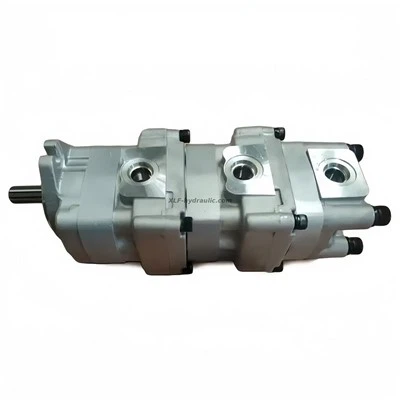
VVP Series Low Pressure Variable Double Vane Pumps for Wheeled Tractor
Warranty:1 Year
Displacement:Depend on Model
Pump Type:Vane Pump
Other attributes:Showroom Location
Place of Origin:Guangdong, China
Weight:40
Wuhan Xinlaifu Hydraulic Equipment Co., Ltd. is one of the leading manufacturers and suppliers of vvp series low pressure variable double vane pumps for wheeled tractor in China. With abundant experience, we warmly welcome you to buy high quality customized products at competitive price from our factory. Also, OEM&ODM service is available.
VVP Series Low Pressure Variable Double Vane Pumps For Wheeled Tractor
The choice for hydraulic power matching of wheeled tractors
In the operation of wheeled tractors, the hydraulic system needs to provide stable power for actions such as steering and lifting farm tools (such as plows and seeders). The VVP Series Low Pressure Variable Double Vane Pumps are specially designed for wheeled tractors and can precisely match their low-pressure working conditions, becoming a reliable power source for the hydraulic system. As a double vane pump, it adopts a double-blade structure design. The contact area between the blades and the pump body is larger, which can transfer power more evenly during rotation, reduce pressure fluctuations caused by uneven force on a single blade, and ensure smooth operation of the tractor when turning or lifting farm tools. Meanwhile, its variable vane feature can automatically adjust the displacement according to the actual load - when the tractor is running empty, the displacement decreases to save energy consumption; When it is necessary to lift heavy objects, the displacement is increased to provide sufficient power, perfectly adapting to the diverse operation requirements of tractors.
Core advantage: Balancing low-voltage stability and energy consumption optimization
This Pump, as a low pressure Pump, can maintain stable operation in a low-pressure environment (with a working pressure range of 8-16 mpa), and is highly suitable for the "low pressure and high efficiency" requirements of the hydraulic system of wheeled tractors. The traditional high-pressure Pump is prone to energy waste under the low-pressure working condition of the tractor. However, this low pressure Pump optimizes the internal flow channel design to increase the volumetric efficiency to more than 90%, reducing fuel consumption while meeting the power demand. Its double-vane structure further enhances stability at low pressure: The double vane design makes the hydraulic oil output more continuous, avoiding the flow pulsation that may occur in single-vane pumps at low pressure, making the steering operation of the tractor smoother and the lifting speed of the farm tools more uniform.
The adjustment function of variable vane is another highlight. The built-in pressure sensing device of the pump can monitor the system load in real time and automatically adjust the extension length of the blades to adjust the displacement. For example, when the tractor switches from no-load driving to towing the ploughing field, the variable vane structure will respond quickly to the load change, increase the displacement to ensure the stability of the ploughing depth into the soil, and adapt to different working scenarios without manual adjustment, greatly enhancing the operational convenience.
Technical features: Tailor-made for wheeled tractor scenarios
- Double-vane power transmission: The double vane structure adopts a symmetrically arranged vane design that closely adheres to the inner wall of the pump cavity, reducing oil leakage at low pressure and simultaneously slowing down the vane wear rate, thereby extending the pump's service life.
- Intelligent variable regulation: Relying on the variable vane technology, the pump's displacement can be steplessly adjusted within the range of 5-25L/min. Precise flow control is achieved through subtle changes in blade angles, meeting the different needs of tractors from low-speed operation to high-speed travel.
- Low-pressure adaptation optimization: As a low pressure Pump, its sealing parts are made of special materials for low pressure, which can still maintain good sealing performance in a low-pressure environment and prevent oil leakage. Meanwhile, the pump body is made of lightweight aluminum alloy to reduce the additional load on the tractor.
- Anti-impurity capacity: The internal filter screen structure can filter out fine impurities in the hydraulic oil, adapting to the dust, oil stains and other environments that the tractor may come into contact with during operation, and reducing the probability of faults caused by impurities.
Product Description


Model Designation
| VVP | 20/20 | A2 | R |
| Series | Flow code | pressure range | Rotation |
| 20/20 | A 8-20 | ||
| low pressure variable double vane pumps | 30/30 | B 15-35 | R-Right hand for clockwise |


Technical Data
| Model | Flow code (cc/rev) | Max. pressure (MPa) | Speed range (rpm) | Piping size | Weight (kg) | ||
| Inlet | Outlet | Drain port | |||||
| VVP1-20/20 | 11.1+11.1 | 70 | 800~1800 | 1/2" | 3/8" | 3/8" | 9.5 |
| VWP2-30/30 | 16.6+16.6 | ||||||
| VVP2-40/40 | 22.2+22.2 | 3/4" | 1/2" | 1/2" | 17 | ||
To protect your rights please read the following carefully Pump Start-up Procedure Preparation Prior to Start-up The reservoir and circuit should be clean and free of dirt and debris prior to filling with fluid. Circuit Cleanup The reservoir should be charged with filtered hydraulic fluid. The fluid level should be sufficient to prevent vortexing at the suction connection to the pump inlet. It is good practice to clean the system by flushing and filtering, using an external slave pump. Filling Pump and Removing Air If the pump is mounted above the fluid level, it should be filled with fluid through the outlet port. If the pump is mounted below the fluid level, the pump outlet fitting (or other downstream fitting or plug) can be loosened to allow fluid to displace the air. It may be necessary to loosen the fill cap on the reservoir to allow the fluid to flow freely. When a solid stream of fluid with no observed air begins to drain through the loosened fitting, the fitting should be retightened. An air bleed valve in the outlet circuit is also recommended to remove trapped air. If such a device is used, the pump should be filled with fluid before start-up. In some cases, it may be possible to prime the pump by running the engine starter for five to ten seconds with the throttle and/or ignition switch in the "off" position. It will be necessary to loosen a fitting or plug in the pump outlet to allow air to escape. Pump Start-up All controls should be placed in the neutral position so the pump is unloaded when started. Start the engine and run at low idle. Once the pump is started, it should prime and pump within a few seconds. If it does not, make sure there are no restrictions between the reservoir and the inlet to the pump, and that there are no air leaks in the inlet line and connections. Also, make sure that trapped air can escape from the outlet. Run at low engine idle for approximately five minutes. Then, while observing the reservoir fluid level, operate the implements. Extend all actuators to maximum safe limits to completely fill the system with fluid. Do not run with the fluid level below the "low" limit. Add fluid to the reservoir to bring the fluid to the proper fill level.
Hot Tags: vvp series low pressure variable double vane pumps for wheeled tractor, China vvp series low pressure variable double vane pumps for wheeled tractor manufacturers, suppliers, cat 134 2947 pump, swash plate axial piston Pump, parker jcb 20 925341, 30vq pump, parker pgp505, mechanical piston pump
You Might Also Like




Send Inquiry