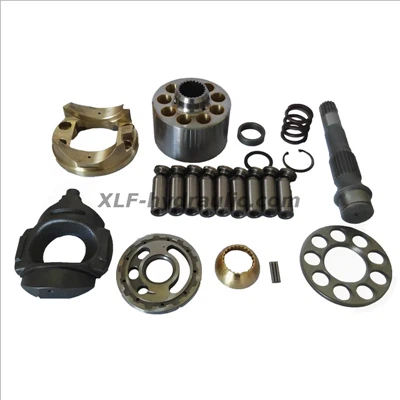
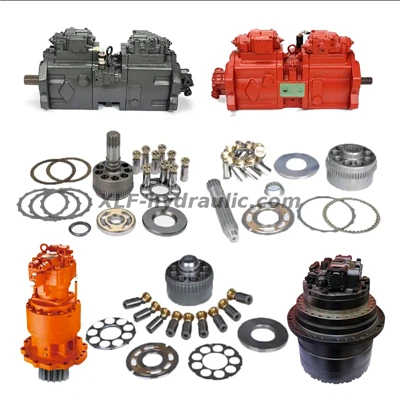
Axial piston pumps are a cornerstone in the world of hydraulic systems, known for their efficiency, reliability, and high - pressure capabilities. As a seasoned axial piston pump supplier, I've witnessed firsthand how the number of pistons in these pumps can significantly influence their performance. In this blog, we'll delve into the intricate relationship between the piston count and the various performance aspects of axial piston pumps.
Flow Rate
One of the most direct impacts of the number of pistons on an axial piston pump is on the flow rate. The flow rate of a pump is defined as the volume of fluid it can displace per unit of time. In an axial piston pump, each piston contributes to the overall fluid displacement during its stroke.
When a pump has more pistons, there are more individual displacement events occurring within a given time frame. This means that for each revolution of the pump's shaft, a larger volume of fluid is displaced. For example, a pump with nine pistons will generally have a higher flow rate than a pump with six pistons, assuming all other factors such as piston size, stroke length, and rotational speed are the same.
However, it's important to note that increasing the number of pistons also increases the complexity of the pump design. More pistons require more precise manufacturing and assembly to ensure smooth operation. This can sometimes lead to higher costs, both in terms of production and maintenance.
Pressure Generation
The ability of an axial piston pump to generate pressure is another critical performance factor affected by the number of pistons. Pressure in a hydraulic system is created when the pump forces fluid against a resistance.
In a pump with a greater number of pistons, the fluid is displaced in smaller, more frequent increments. This results in a more continuous and stable flow of fluid, which is beneficial for pressure generation. When the fluid flow is more continuous, there are fewer pressure fluctuations, and the pump can build up and maintain higher pressures more effectively.
For instance, in heavy - duty applications such as large construction equipment or industrial presses, pumps with a higher number of pistons are often preferred because they can generate and sustain the high pressures required for these operations. The Rexroth A10VSO Series 31 Axial Flow Pump and Centrifugal Pump for Excavators is designed with a specific number of pistons to optimize pressure generation for the demanding tasks of excavators.
Efficiency
Efficiency is a key consideration in any hydraulic system, and the number of pistons in an axial piston pump plays a crucial role in determining its efficiency. There are two main types of efficiency to consider: volumetric efficiency and mechanical efficiency.
Volumetric efficiency refers to the ratio of the actual flow rate of the pump to its theoretical flow rate. A pump with more pistons can have higher volumetric efficiency because the more frequent displacement events reduce the chances of fluid leakage and compressibility losses. With a greater number of pistons, the fluid is more evenly distributed and pumped, minimizing the voids and backflow that can reduce the actual flow rate.


Mechanical efficiency, on the other hand, is related to the power input and output of the pump. More pistons can result in a more balanced load on the pump's shaft and other components. This balanced load reduces friction and wear, leading to higher mechanical efficiency. However, as mentioned earlier, the increased complexity of a pump with more pistons can also introduce additional frictional losses if not properly designed and maintained.
Noise and Vibration
Noise and vibration are important factors, especially in applications where a quiet and stable operation is required. The number of pistons in an axial piston pump can have a significant impact on these aspects.
A pump with a lower number of pistons tends to produce more noise and vibration. This is because the fluid displacement events are less frequent and more abrupt. Each piston stroke creates a sudden change in fluid pressure, which can cause vibrations in the pump and the surrounding hydraulic system. These vibrations can then be transmitted as noise.
In contrast, a pump with a higher number of pistons has a more continuous and smooth fluid displacement. The smaller and more frequent strokes result in less pressure variation, reducing both noise and vibration. For example, in applications such as precision machining or indoor industrial operations, pumps with a higher piston count are often selected to minimize noise and vibration levels.
Cost and Application Suitability
The cost of an axial piston pump is closely related to the number of pistons. As the number of pistons increases, so does the cost of manufacturing, as more components are required, and the manufacturing process becomes more complex. Additionally, maintenance costs can also be higher for pumps with more pistons, as there are more parts that can potentially fail.
When choosing an axial piston pump, it's essential to consider the specific application requirements. For applications that require high flow rates, high pressures, and low noise levels, a pump with a higher number of pistons may be the best choice, even though it comes at a higher cost. On the other hand, for less demanding applications where cost is a major concern, a pump with a lower number of pistons may be sufficient.
The Parker Jcb 20/925341 Hydraulic Hydraulic Piston Pumps for Crawler Bulldozers is designed to meet the specific needs of crawler bulldozers. The number of pistons in this pump is carefully selected to balance performance, cost, and durability for this particular application. Similarly, the GP PISTON 980H Parts Hydraulic Piston Pump for CAT Wheel Loader 980G is optimized for the requirements of the CAT wheel loader, taking into account factors such as flow rate, pressure, and efficiency.
Conclusion
In conclusion, the number of pistons in an axial piston pump has a profound impact on its performance in terms of flow rate, pressure generation, efficiency, noise and vibration, and cost. As a supplier, I understand the importance of helping customers choose the right pump for their specific applications.
If you're in the market for an axial piston pump, it's crucial to carefully evaluate your requirements and consider how the number of pistons will affect the pump's performance. Whether you need a high - performance pump for heavy - duty applications or a cost - effective solution for less demanding tasks, we can provide you with the expertise and products to meet your needs.
If you're interested in learning more about our axial piston pumps or have specific requirements for your application, please don't hesitate to reach out for a detailed discussion and potential purchase negotiation. Our team of experts is ready to assist you in finding the perfect pump for your hydraulic system.
References
- "Hydraulic Pumps and Motors" by George Rideout
- "Fluid Power with Applications" by Anthony Esposito